
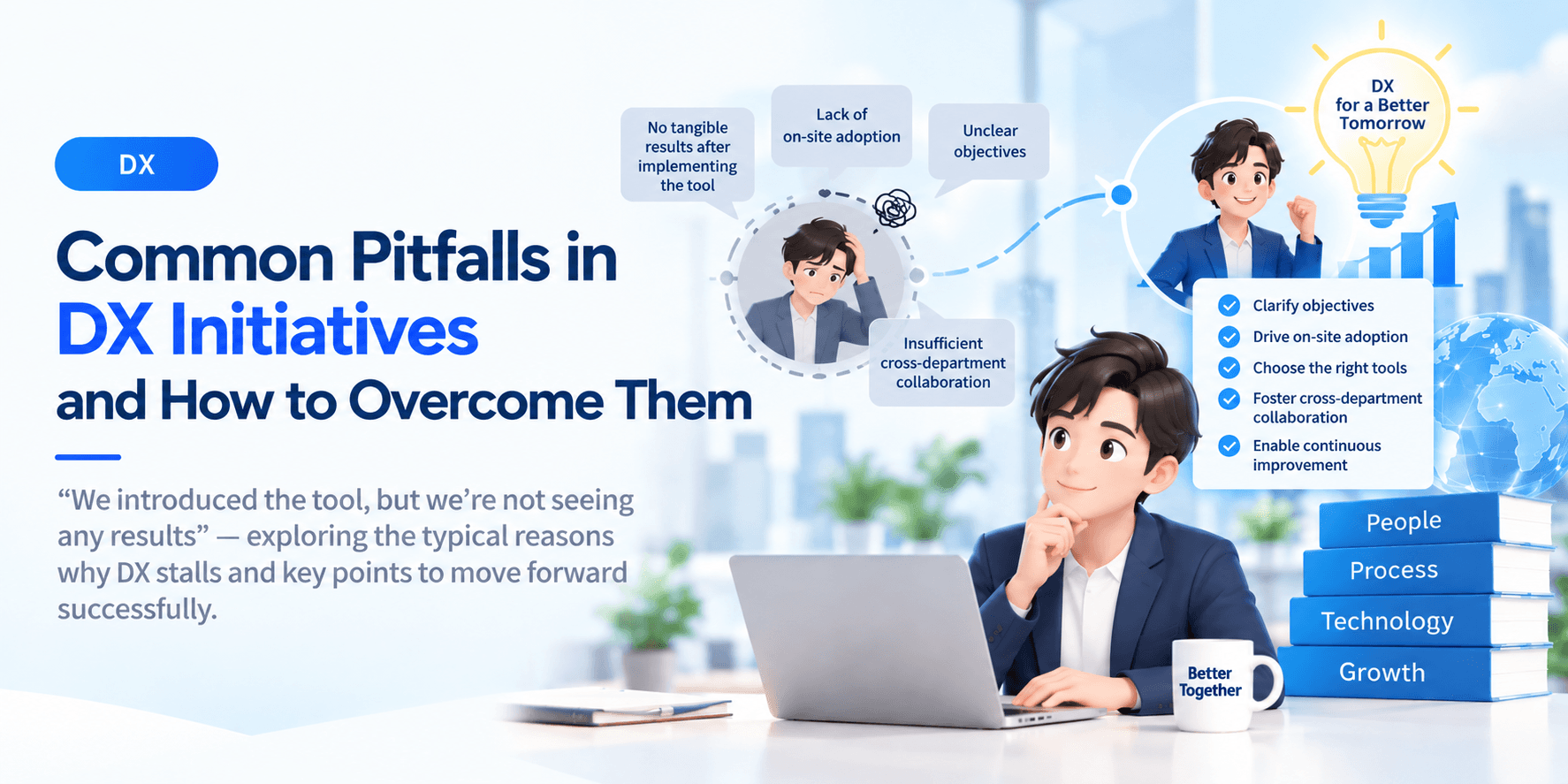
As more companies take on digital transformation (DX), it's common to hear "we introduced the tools, but they haven't led to results." This article organizes the typical reasons DX initiatives stall, along with practical points for overcoming them.
Typical Reasons DX Stalls
- Tools get introduced before the purpose is clear — A trending tool gets adopted before anyone has pinned down what the DX effort is actually for.
- Design proceeds without understanding how the frontline actually works — A system gets built without reflecting how work really happens on the ground, so it ends up unused.
- Lack of cross-departmental alignment keeps initiatives locally optimized — Each department optimizes for itself, making it hard to produce company-wide results.
Three Perspectives for Driving Results
- Work backward from management challenges — First clarify the management and business challenges that need solving, then design the initiatives needed to address them.
- Design with the frontline involved — Build a realistic transition plan after understanding how work actually flows on the ground.
- Start small and validate — Start on a small scale, validate the impact, and expand the scope in stages.
Key point: What separates successful DX from failed DX isn't "how sophisticated the tool is" — it's how well it takes root in the business and the organization. A plan that accounts for post-launch operation and adoption support is essential.
Bringing In an External Partner
When a company lacks in-house specialists to drive DX, working alongside an external development partner can also be effective. Bringing the partner in from the requirements-definition stage helps prevent gaps in understanding the frontline.
Summary
The essence of DX isn't introducing tools — it's how well those tools take root in the business and the organization. Involving the frontline and repeating small validation cycles is the fastest path to real results.